Cookies In PHP
PHP cookie is a small piece of information that is stored at the client's browser. It is used to recognize the user.
Cookie is created at the server-side and saved to the client browser. Each time when a client sends a request to the server, the cookie is embedded with the request. Such a way, a cookie can be received at the server-side.
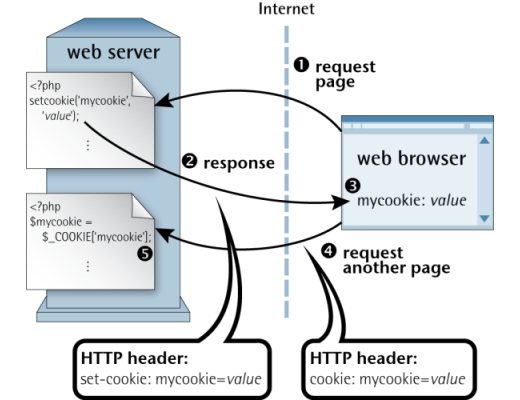
In short, a cookie can be created, sent and received at the server end.
Setting Cookies with PHP
PHP provided setcookie() function to set a cookie. This function requires upto six arguments and should be called before <html> tag. For each cookie this function has to be called separately.
setcookie(name, value, expire, path, domain, security);
Here is the detail of all the arguments −
- Name − This sets the name of the cookie and is stored in an environment variable called HTTP_COOKIE_VARS. This variable is used while accessing cookies.
- Value − This sets the value of the named variable and is the content that you actually want to store.
- Expiry − This specify a future time in seconds since 00:00:00 GMT on 1st Jan 1970. After this time cookie will become inaccessible. If this parameter is not set then cookie will automatically expire when the Web Browser is closed.
- Path − This specifies the directories for which the cookie is valid. A single forward slash character permits the cookie to be valid for all directories.
- Domain − This can be used to specify the domain name in very large domains and must contain at least two periods to be valid. All cookies are only valid for the host and domain which created them.
- Security − This can be set to 1 to specify that the cookie should only be sent by secure transmission using HTTPS otherwise set to 0 which mean cookie can be sent by regular HTTP.
Create Cookies With PHP
A cookie is created with the setcookie() function.
Syntax
setcookie(name, value, expire, path, domain, secure, httponly);
Note: PHP Cookie must be used before <html> tag.
PHP setcookie() function
PHP setcookie() function is used to set cookie with HTTP response. Once cookie is set, you can access it by $_COOKIE superglobal variable.
Syntax
bool setcookie ( string $name [, string $value [, int $expire = 0 [, string $path
[, string $domainName [, bool $secure = false [, bool $httponly = false ]]]]]] )
Example
setcookie("CookieName", "CookieValue");/* defining name and value only*/
setcookie("CookieName", "CookieValue", time()+1*60*60);//using expiry in 1 hour(1*60*60 seconds or 3600 seconds)
setcookie("CookieName", "CookieValue", time()+1*60*60, "/mypath/", "easytolearning.com", 1);
PHP $_COOKIE
PHP $_COOKIE superglobal variable is used to get cookie.
Example
$value=$_COOKIE["CookieName"];//returns cookie value
PHP Cookie Example
File Name: cookie_name.php
<?php
setcookie("user", "Suhail");
?>
<html>
<body>
<?php
if(!isset($_COOKIE["user"])) {
    echo "Sorry, cookie is not found!";
} else {
    echo "<br/>Cookie Value: " . $_COOKIE["user"];
}
?>
</body>
</html>
Deleting Cookie with PHP
Officially, to delete a cookie you should call setcookie() with the name argument only but this does not always work well, however, and should not be relied on.
It is safest to set the cookie with a date that has already expired −
<?php
   setcookie( "user", "", time()- 60, "/","", 0);
?>
<html>
  <head>
      <title>Deleting Cookies with PHP</title>
  </head>
  <body>
      <?php echo "Deleted Cookies" ?>
  </body>
</html>